

EMI Locker in India: What Every Mobile Retailer Must Know Before Buying One

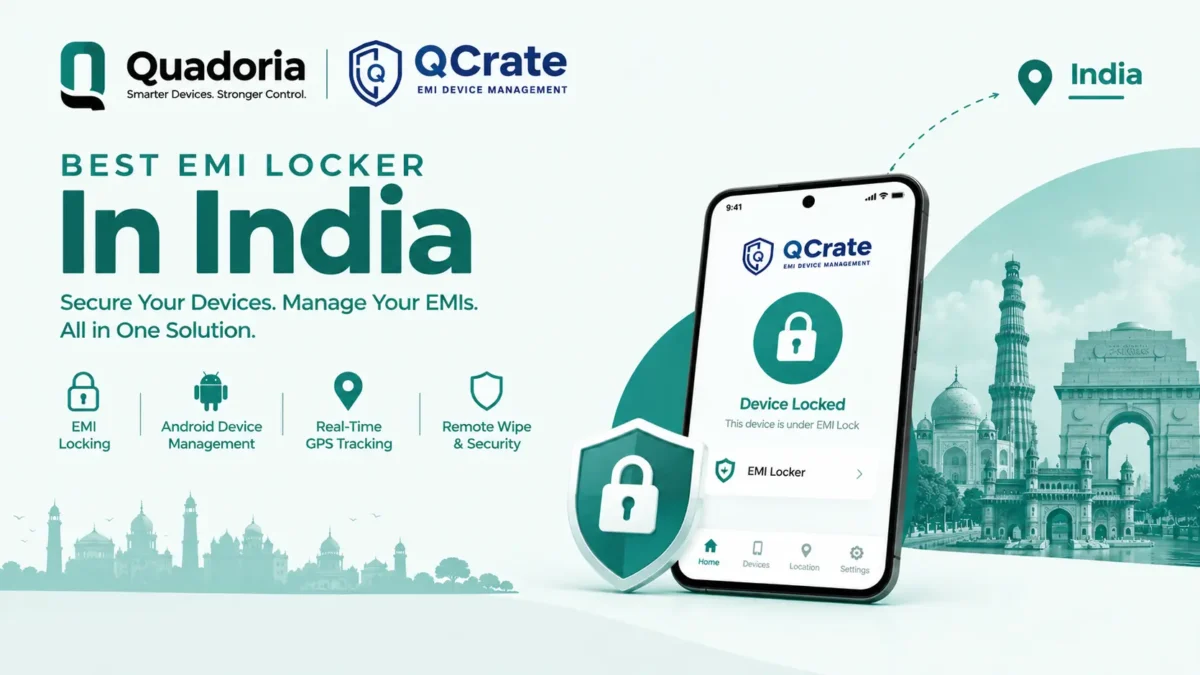
An EMI locker in India is software that allows a mobile retailer to restrict a financed phone when an instalment is overdue and release it once payment is received. It is now a standard risk-control tool for shops that sell smartphones on EMI.
Choosing the right one is not only a technology decision. It affects your cash flow, your customer relationships and your legal position. This guide explains how an EMI locker works, whether it is a good idea, what to evaluate before you buy, and how Qcrate by Quadoria adds e-mandate and auto-pay to the standard lock feature.
What Is an EMI Locker?
An EMI locker is an Android application, paired with a web dashboard, built for phones sold on instalments. It has two parts:
- A device app, installed by the retailer before the phone is handed over.
- A retailer dashboard, where every device, due date and payment is tracked.
Common alternative names include EMI lock app, finance lock app and EMI locker software. Many platforms also include MDM (mobile device management), which lets a business track devices, control apps and secure phones remotely from one screen.
How Does an EMI Locker Work on a Phone?
An EMI locker in India follows a simple six-step process:
- Enrolment. The retailer installs the app at the time of sale and links the phone to the dashboard.
- EMI plan setup. The price, down payment, number of instalments and due dates are entered.
- Reminders. The customer receives reminders before each due date.
- Payment tracking. The dashboard shows which customers are on time and which are overdue.
- Lock on missed payment. If an instalment is overdue, the retailer restricts the phone from the dashboard. A message tells the customer how to resolve it.
- Unlock on payment. Once payment is confirmed, the retailer releases the phone, usually in one step.
Is an EMI Locker Good or Bad?
An EMI locker is neither good nor bad on its own. The outcome depends on how it is used.
Benefits
- Lower losses from non-payment
- Wider access to EMI for customers without a credit history
- Less staff time spent on recovery calls
- A complete digital record of every device and payment
Risks when misused
- Locking a phone without prior written consent
- Locking immediately after a one-day delay, with no reminder
- Collecting more customer data than necessary
- Delaying the unlock after the customer has paid
A retailer who explains the terms, allows a reasonable grace period and unlocks promptly gets the benefits. A retailer who skips these steps invites complaints and reputational damage.
Why Retailers Are Adopting an EMI Locker in India
EMI has made smartphones accessible to many first-time buyers, including in smaller towns. For retailers, this increases sales and also increases credit exposure.
Consider a simple illustration, not a statistic:
- A shop sells 100 phones a month on EMI at an average price of ₹12,000.
- Eight of those customers stop paying.
- The shop loses stock worth roughly ₹96,000 in a single month.
An EMI locker gives the retailer a structured way to act early, before a missed instalment becomes a total loss. Preventing even one or two defaults a month can offset the cost of the software. Retailers who feel protected are also more willing to offer EMI to more customers, which supports sales growth.
What to Look for in an EMI Locker in India
Use the checklist below when evaluating any provider.
| Criteria | Why it matters |
|---|---|
| Fast, reliable lock and unlock | This is the core function and must work consistently |
| Automatic EMI collection | Collecting on time reduces the need to lock |
| Real-time payment tracking | Replaces paper registers and spreadsheets |
| Device tracking | Useful when a phone moves or goes missing |
| Tamper protection | Ask how uninstall and reset attempts are handled |
| App management | Controls what runs on a locked or company phone |
| Written pricing | Avoids hidden charges per device or per lock |
| Consent and privacy controls | Protects both the retailer and the customer |
| Reliable support | Needed most during festival and weekend sales |
Collect First, Lock Second: Why Auto-Pay Matters
A lock is a response to a missed payment. A stronger approach is to prevent the missed payment.
Most late instalments are not deliberate. Customers forget a due date, the date falls in a busy week, or the funds are not in the account on that day. A lock addresses the consequence but not the cause.
This is where e-mandate and auto-pay add value:
- An e-mandate is a one-time digital authorisation, approved by the customer through their bank or payment app.
- Auto-pay then collects each instalment on its due date without manual follow-up.
When instalments are collected automatically, fewer phones need to be locked, fewer reminder calls are needed and cash flow becomes more predictable. Most EMI lockers focus only on the lock itself. Combining collection and locking in one dashboard is simpler for staff and more considerate for customers.
How Qcrate Strengthens an EMI Locker in India
Qcrate is an Android MDM platform with built-in EMI locking, developed by Quadoria, an IT company based in Indore. It is designed to cover the full EMI cycle, from collection to follow-up, from a single dashboard.
Key capabilities
- E-mandate and auto-pay: Automated EMI collection on the due date.
- EMI locking: Lock and unlock phones based on payment status.
- Real-time tracking: Monitor device status from the dashboard.
- Remote security: Lock, manage or wipe a device remotely when required.
- App management: Control which applications run on each phone.
Two layers of protection
- Auto-pay collects the instalment on the due date.
- If a payment still fails, the EMI lock provides a structured way to follow up.
Because Quadoria is based in Indore, retailers in the region can get hands-on onboarding. Retailers elsewhere should ask about onboarding and support in their city. For location-specific guidance, see our guides on the best EMI locker and MDM solution in Indore, the EMI locker and MDM guide for Lucknow, the EMI locker and MDM solution for Kolkata and many more
Which EMI Locker Is Best for Your Shop?
No single product suits every retailer. The right choice is the one that passes a practical test. Before deciding, request a live demo and verify the following:
- Lock and unlock work within seconds on a real phone.
- The platform can collect EMIs automatically, not only lock devices.
- Counter staff can learn the dashboard within a day.
- Pricing is provided in writing.
- The company explains consent and data privacy clearly.
- Support is available when something goes wrong.
You can run this evaluation on Qcrate by booking a demo with the Quadoria team.
Is an EMI Locker in India Legal? Consent and Compliance
EMI lockers are widely used by retailers. Legal and reputational risk depends on how they are used.
- Obtain written consent at the time of sale, explaining that the phone can be restricted if payments are missed.
- Disclose data collection. State what the app collects and why.
- Follow the rules for recurring payments. E-mandates are governed by guidelines from the Reserve Bank of India, and the customer must approve them. The UPI side of recurring payments is explained by NPCI.
- Offer a fair process. Send reminders, allow a short grace period and unlock promptly after payment.
- Know the complaint route. Customers can raise disputes through the National Consumer Helpline, so a clear process protects your business as well.
- Follow lender requirements if you sell through an NBFC or finance partner.
Regulations change, so consult a legal adviser before finalising your EMI agreement. For background on how Android devices are managed in business settings, Google’s Android Enterprise overview is a useful reference.
Cost of an EMI Locker in India
Pricing depends on the provider, the number of devices and the features included. Common models are:
- Per device: a fee for each phone enrolled.
- Monthly subscription: a fixed fee for platform access.
- One-time fee: more common with small or custom developers.
Whichever model you consider, ask for a written price list and confirm whether locks, support or reports carry extra charges. To request a quote for Qcrate, contact Quadoria with your expected number of phones and branches.
Mistakes to Avoid When Using an EMI Locker in India
- No written consent. This is the most common cause of disputes.
- Locking too early. Send a reminder first and allow a grace period.
- Skipping the demo. Always test on a real phone.
- Choosing on price alone. Low cost with weak support is expensive when something fails.
- Untrained staff. One incorrect action can lose a good customer.
- No unlock routine. A customer who has paid should not remain locked.
Getting Started: A Five-Step Process
- Define your EMI policy: down payment, tenure and grace period.
- Attend a live demo: test locking, unlocking and auto-pay.
- Enrol every phone at the time of sale and record written consent.
- Set pre-due reminders: these prevent most locks.
- Train your staff on one clear process.
Once the routine is in place, it adds only a few minutes to each sale.
Frequently Asked Questions
What is an EMI locker in India?
An EMI locker in India is an app and dashboard that lets a retailer remotely lock and unlock a phone sold on instalments, based on whether payments are on time.
How does an EMI locker work on a phone?
The retailer installs the app at the time of sale and links the phone to a dashboard. If a payment is missed, the phone is restricted. When the customer pays, it is released.
Is an EMI locker good or bad?
It is beneficial when used with written consent and fair rules, because it reduces losses and helps more customers buy on EMI. It causes problems when retailers lock without notice or handle customer data carelessly.
Which EMI locker is best?
The best EMI locker is fast, simple to use, transparent on pricing and supported by responsive service. Test lock, unlock and auto-pay on a real phone before buying.
Which company in India offers an EMI locker?
Several companies offer EMI lockers. Quadoria, an Indore-based IT company, offers Qcrate, an Android MDM platform with EMI locking, e-mandate and auto-pay.
Does Qcrate support e-mandate and auto-pay?
Yes. Qcrate includes e-mandate and auto-pay along with EMI locking, so instalments can be collected automatically on the due date. Contact the Quadoria team for a demo.
What is the benefit of auto-pay in an EMI locker?
Auto-pay collects instalments on time, so fewer customers miss payments and fewer phones need to be locked. It also reduces the need for manual reminder calls.
Is an EMI locker legal in India?
EMI lockers are widely used by retailers. The key requirements are clear written consent, transparent terms and responsible handling of customer data. Consult a legal adviser for your specific setup.
Can a customer remove an EMI locker app?
A reliable platform includes tamper protection. Ask the provider how it handles uninstall and reset attempts on the phone brands you sell.
Does an EMI locker work on iPhones?
Most EMI lockers are built for Android devices. Always confirm supported devices with the provider.
Hinglish FAQs
EMI locker kaise install kare?
Phone dene se pehle app install karein, customer ki likhit permission lein aur phone ko dashboard mein enrol karein. Demo ke liye Quadoria team se sampark kar sakte hain.
EMI locker phone mein kaise kaam karta hai?
Phone bechte samay app install karke dashboard se link kiya jata hai. EMI miss hone par phone lock hota hai, aur payment ke baad turant unlock ho jata hai.
Kya EMI locker mein auto-pay hota hai?
Qcrate mein e-mandate aur auto-pay dono available hain. Customer ek baar permission deta hai, aur EMI due date par apne aap collect ho jati hai. Isse EMI miss hone ke chances kam hote hain.
EMI locker achha hai ya bura?
Agar customer ki likhit permission ho aur niyam spasht hon, to yeh dukaan aur customer dono ke liye faydemand hai. Bina bataye lock karna galat hai.
Conclusion
An EMI locker in India helps retailers protect stock, reduce defaults and offer EMI with greater confidence. The most effective setups go beyond locking and collect payments automatically, so a lock is rarely needed.
Qcrate combines e-mandate, auto-pay, EMI locking, device tracking and app management in one dashboard. To see how it fits your business, explore Qcrate or contact Quadoria for a demo.